Tuesday, September 07, 2010
Bugs as a Language Infiltrator
This piece was sent to me recently from a cousin in the Old Country. The headline, "Srbi u šoku: Djeca govore hrvatski jezik zbog crtićaVećina crtanih filmova u Srbiju dolazi iz Hrvatske," translates as "The Serbs are in shock: Children speak Croatian language because the majority of animated cartoons that are broadcast in Serbia come from Croatia". One especially irate parent wrote to a station saying his 4 year old son call him "tatek" now instead of "otac" ("daddy" as opposed to "father"). The war in the Balkans is still raging, though at a less violent rate. Now nefarious agents of the animated sort are serving as conscripts in the battle of ethnic differences.
 For those folks without excessive time on their hands to study the minutiae of the Croatia/Serbia/Yugoslavia conflict, I'm here to help. Way back in the days of the mid 1800's, when the main ethnic groups that constituted what was to be, in the early 1900's, Yugoslavia, the major powers that were, namely the Austrians, Hungarians, and Turks noticed the similarities between the Croatian & Serbian languages. A meeting, where the Vienna Literary Agreement was concocted, was held in 1850 wherein a combo artifical language of Serbo-Croatian was agreed to. (That must have been a hellacious meeting as only one Slovenian was invited and, as you can tell by the language name, his opinion was minimally included). But the practioners of this "new" language never seemed to take it firmly into their bosoms, i.e., in some parts of the the areas affected it was called Croatian-Serbian, in others just (still) Serbian or Croatian. Even though this part of the world was in perpetual change as invasion by various powers was seemingly a daily occurence, the occupants were not eager acceptors of change. (No surprise that the symbol for this part of the world is the magarac). Any incursion was an effront.
So, these days, with the break-up of the artificially created Yugoslavia (think of the British-concocted Iraq except without the oil resources) permanent (...uhmmm, that is, for the mooment), the language thing is once again a point of pride and of conflict. If you happen to be in Serbia or in Croatia (or any of the other former republics of the Federal Socialist Republics of Yugoslavia), you'd do well (and be safe) to NEVER use the term Serbo-Croatian in defining the language of that country. It's either Serbian, Croatian, or Slovenian or...you get the idea. So, now Bugs and his cartoon pals seem to be hired guns in the ongoing conflict of Slavic differentiation in the The Land of Croats and The Domain of Serbs. Chillin' will never be a national pastime in either of these places. Even the philosophy of fjaka takes a backseat to opportunities to moan.
So, these days, with the break-up of the artificially created Yugoslavia (think of the British-concocted Iraq except without the oil resources) permanent (...uhmmm, that is, for the mooment), the language thing is once again a point of pride and of conflict. If you happen to be in Serbia or in Croatia (or any of the other former republics of the Federal Socialist Republics of Yugoslavia), you'd do well (and be safe) to NEVER use the term Serbo-Croatian in defining the language of that country. It's either Serbian, Croatian, or Slovenian or...you get the idea. So, now Bugs and his cartoon pals seem to be hired guns in the ongoing conflict of Slavic differentiation in the The Land of Croats and The Domain of Serbs. Chillin' will never be a national pastime in either of these places. Even the philosophy of fjaka takes a backseat to opportunities to moan.
Labels: Croatia, Humans, Idiosyncracies


Wednesday, January 20, 2010
"When you go to someone’s house, meat is the first thing you get."

, says Julia Jaksic, the chef at Employees Only, the West Village restaurant on whose late-night menu she has put an untraditional "Balkan burger" made with pork, fennel seeds and other aromatics. In today's NYT Food Section, pljeskavica and cevapcici are given quite a lot of space for extolling and for encouragement of the watering of one's mouth.
The articel is particularly refreshing as the writer has a solid take on the famed pronouncements delivered by folks of the Croatian/Serbian persuasion. For countries of comparatively minor size (Bob Costas famously announced the winner of an Alpine event in the Winter Olympics a few years back as "Janica Kostelić, from the teeny-tiny country of Croatia"), it is truly amazing that statements of larger-than-life gravity are typically spoken. But then, there is no country that can lay total ownership on chutzpah.
Labels: Croatia, Only in America
Friday, June 19, 2009
Meaning Of...

When first presented with my name, folks tended to hesitate, pull their ear, perhaps even stick a twisted up handkerchief, a la The 3 Stooges, into their right ear and pull it out their left ear.
"Had I heard that correctly?", their face indicates?
Yes, it is Darko.
"And, uhmmmm, what does it mean", comes the usual response indicating that a meaning must be available to help clear up the matter.
I've always told folks that Darko has no meaning; it's simply one of those Croatian things. Inexplicable.
Now, it seems, there's a web site explaining all.
Or so it seems.
Per the site, "Damir" means "Yes Peace". Which is true....sort of. If you split up the name, "Da" does mean "Yes" and "Mir" means "Peace". But "Yes Peace", even when considering how clunky translations can be, sounds awfully....stupid (and primitive), wouldn't you say?
Continuing, per the site, "Darko" means "Gift". Let's look at that a bit closer.
"Dar" does mean "Gift".
But, using the same logic as "Damir" then, you have to come up with the translation for "ko".
"Ko" is a shortened version of "Tko", which means "Who". So, stretching things here, it seems "Darko" means "Gift Who", suggesting something along the lines of, "Gift? Who thinks he's a Gift!?!?".
Not exactly the thought I'd like to give people when I first meet them. Afterwards, they may well think, "Gift? He's more of a Burden!", but that would at least would give me a physical and temporal distance before they would decide if some time to get to know me would be worth the "Darko" mystery.
This whole "gift" thing will play well into the Ever-Loving Wife's hands. My mother, bless her broken Croatian-English vocabulary, has mentioned on occasion to the ELW that I'm a jewel, i.e. a very specific and highly-prized type of gift. The ELW jury's still out on that one, debating whether I'm precious, semi-precious, or simply industrial grade.
Labels: Croatia, Personalities
Tuesday, April 07, 2009
Water, Beer, & Thinking
 ...do not do so well in the part of the world known previously as the Land of the Southern Slavs. Throw in some warm weather, the inbred Slavic need for 24/7 tuneage, and thoughts of the summer that will be the best of all Summers (as most Summers tend to be thought of in the preceding Spring) and you're asking for calls to 911.
Here's to warming weather and a thinning of the herd.
Labels: Croatia, Idiosyncracies, People
Thursday, December 11, 2008
Delusional Self-Gazing
Jim, sitting over there in PA at SerotoninRain, open-armed offered a great idea for a post.
 Seven Posts About the Same Thing
A great way to relapse into past doings with hopes of reviving interest in one's navel-gazing. I'm all for that navel-gazing, especially these days as it keeps my eyes from tearing up each time I look at any financial news.
So, how about a hop, skip, and a jump down the Croatia memory lane?
A few years back, before financial meltdowns quashed any plans or even dreams of foreign travel, the fam had a chance to visit the Land of Croats.
Getting into the right mood for a trip there was difficult. I know my mojo had been on sabbatical, but my fjaka? Well, I'd become too much of an American, sorry to say and to realize, to possibly ever retrieve it.
Thank goodness, there were distractions to keep me from wallowing in that loss. Frankopanska torta, a hallucinogenic drug disguised as a cake was a welcome reprieve.
The natives, as friendly and non-critical as I remembered them, were also there to uplift one's mood.
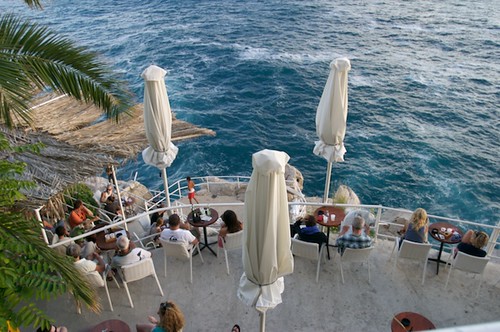
My of my many cousins, a raconteur of the highest order, made sure we were parked at various cafes' umbrellaed tables while he regaled us with tales of business and travel.
Once our inhibitions had been loosened with rakija and vino, everything was possible. Even visitations back to the sartorial splendor of Speedos.
And when everything came together? Speedos, rakija, wine, and food? Well, that meant we were in Ston, enjoying a particularly fresh meal.
Ziveli to all and to all a Good Night!
Seven Posts About the Same ThingA great way to relapse into past doings with hopes of reviving interest in one's navel-gazing. I'm all for that navel-gazing, especially these days as it keeps my eyes from tearing up each time I look at any financial news.
So, how about a hop, skip, and a jump down the Croatia memory lane?
A few years back, before financial meltdowns quashed any plans or even dreams of foreign travel, the fam had a chance to visit the Land of Croats.
Getting into the right mood for a trip there was difficult. I know my mojo had been on sabbatical, but my fjaka? Well, I'd become too much of an American, sorry to say and to realize, to possibly ever retrieve it.
Thank goodness, there were distractions to keep me from wallowing in that loss. Frankopanska torta, a hallucinogenic drug disguised as a cake was a welcome reprieve.
The natives, as friendly and non-critical as I remembered them, were also there to uplift one's mood.
My of my many cousins, a raconteur of the highest order, made sure we were parked at various cafes' umbrellaed tables while he regaled us with tales of business and travel.
Once our inhibitions had been loosened with rakija and vino, everything was possible. Even visitations back to the sartorial splendor of Speedos.
And when everything came together? Speedos, rakija, wine, and food? Well, that meant we were in Ston, enjoying a particularly fresh meal.
Ziveli to all and to all a Good Night!
Labels: Croatia, Life Decisions, Links to Posts, Road Trips
Wednesday, August 27, 2008
Delightful, An Overusage.
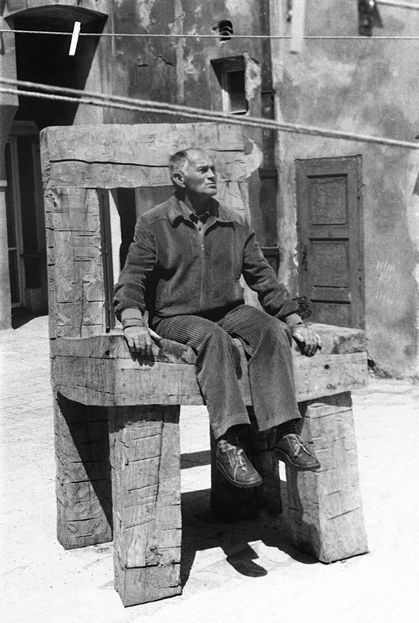 This delightful book, pointed out by and enthusiastically endorsed by this delightful blogger has been made into a delightful movie by Jiri Menzel, a delightful Czech who had earlier adapted another of Bohumil Hrabal's novels, Closely Watched Trains, into a 1967 Academy Award winning movie.
A New Yorker review, delightful, but of course, by David Denby is here.
This is so...delightful. Can't wait when the movie hits Philly.
8/29 Addendum: Today's NYT's review.
A little (No, make that a huge) aside:
Whenever a cousin and I would get into conversation regarding the most beautiful place in the world to go for vacation, the topic of tourists would come up. I would tend to take in the information he passed on to me with a touch of disbelief, in part due to the, as he puts it, the "Americanization" of myself. If I protested even a bit about the broad generalizations that he would make as regards certain European nationalities, he'd shake his head and say, "Pa pogledaj se; bas si postao Amerikanac!" ("Why look at yourself; you really are an American!"). His inflection at the end of the sentence left no doubt that I'd fallen a few rungs in his estimation of me as a cognitive being. Granted, when I think back on my early days, living with generalizations was a much less complicated life. Individualization, as far as foreigners was concerned, was a lot of work and, at that feeble-minded state I was in, usually not worth the time. It seemed as if the generalization were, in general, fairly true. Living in the States, I admit, has deburred the sharp edges of my opinions. The broadening of my views has also made them more elusive. A polite-speak gaseous salve has been applied to the short, sharp, definitive quips. It's not as if my cousin, or my family over in Croatia, were unique in their firm and frothing opinions of other peoples. That view was shared by quite a few of folks over in the continent.
 ACLU would experience total and utter exhaustion dealing with the insulting views that different groups publicly exhibited. While I admitted to my cousin that perhaps living over here has worn down (I preferred the gentler, more uplifting "smoothed over") my opinions regarding nationalities, I argued that he, perhaps, should tone down his rhetoric especially if he's within earshot of the foreign tourists that he is potentially insulting. He especially had it in for the Czechs, as he continually harped on their cheapness, specifically exhibited when they came to the Croatian seaside in their of flotilla of Škodas. Well, now it seems that the government of Croatia has taken these skinflint comments to heart and will be enforcing rules specifically aimed at the Czechs.
Personally, I empathize with the Czechs. I understand their situation as "it’s also a problem of taste. Because Czechs like the taste of Czech sausages, Czech yoghurt and so on - a lot of them prefer their lovely taste. And of course they want also to save money." While the salamis available in the States are large in number, there really is not, IMHO, any salami like Gavrilovic. So, while I will remain neutral on the alleged thriftiness of the Czechs, I will definitely be in their corner as far as their right to bear arms, I mean salami, of their own choice.
Friday, August 08, 2008
Not Necessarily an Honor
This piece from Forbes is not exactly what a country should be aiming for, as far as Top lists are concerned. For anyone who's experienced interactions with Croatians in the Land of Croats, specifically at places that offer alcoholic beverages, an understanding of this dubious honor may be had. All that involved storytelling and singing and the physical and mental gymnastics necessary to correctly conduct those activities must need some kind of fuel, right?
On a positive spin, Fortune determined that Croatia has improved from #62 to #42 as best countries to do business in. Wonder if this honor had anything to do with this one? Oiling the wheels of commerce....
On a positive spin, Fortune determined that Croatia has improved from #62 to #42 as best countries to do business in. Wonder if this honor had anything to do with this one? Oiling the wheels of commerce....
Labels: Croatia
Tuesday, June 17, 2008
Magarac
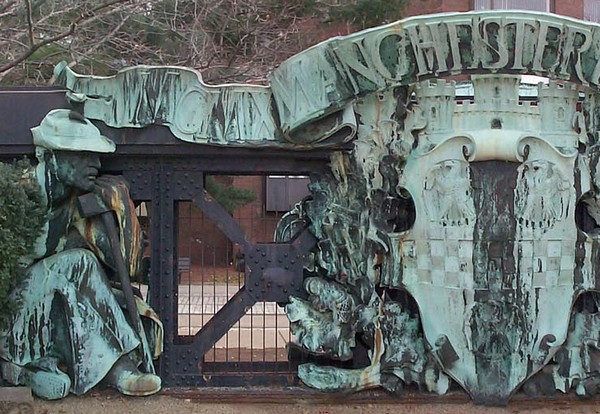 In the Land of Croats, discerning between a compliment and an insult usually requires time, patience, intuitive skills, sharply honed skills in logic and linguistics, and a practiced ear for tone and modality. A full bottle of rakija is not a detrimental thing to have handy either. The Croatian compliment, when finally deciphered, tends to be a pearl wrapped in cobwebs of enigmas, past effronts to one's character, and dope slaps to one's self perception. To a non-Croatian, receiving a Croatian compliment or a Croatian insult seem identical. The delivery usually begins with the gradually raising of a speaker's shoulders, a increase in pitch, and an almost violent shaking of arms, which are usually in the threatening arms akimbo pose. Sometimes, the difference between the positive and the negative comments are not fully comprehended until later.
Much later.
It's been about 3 years since my family came back form a wonderful vacation in the Land of Croats. During our visit, my family had the enjoyment of meeting most of my relatives, who all happen to live in one city. One of my aunts, who happens to be the same height, about 4 ft 6 in., as most of my aunts, greeted me with a dope slap when she found out that I'd failed to teach my Ever-Loving spouse and my children the intricacies and pleasures of the greatest language in the world, Croatian. She then shook her head and called me a magarac, a semi-affectionate sobriquet that I translated for my family.
They had heard my stories of my family but had taken them in with many grains of salt, the large chunky sea salt kind. Pah! My father/husband is again with the exaggerations! The trip to Croatia was necessary simply to show them that though, yes, I do weave the stories with a touch of the Celtic (the Celts first stopped over in Croatia to plant their seed of over-the-top story telling before ending up in Ireland) tendency toward blarney, truth is at the core. Seeing my aunt jumping up with vigor to slap me upside the head was proof that my told tales bore some reality. Not having seen me in over 20 years and proclaiming me a donkey was a delicious frosting to my Croatian cake.
Not having been in the homeland for a while, I took her combo dope slap and "magarac" comment as your typical Croatian insult. Little did I realize that being called a magarac was a compliment!
I think.
An informative entry from Croatia.org is here on Joe Magarac.
Labels: Croatia
Wednesday, June 11, 2008
Heat Things
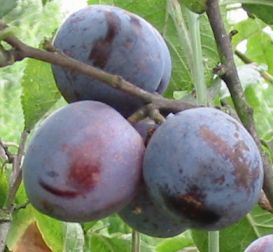 The first of what are promised to be numerous spates of high heat days has just passed. Last tonight's furious sky shows brought buckets of rain, bright jags of lightning, and surprisingly low murmers of thunder and immediately reduced the humidity and the temperature. In the morning, my pillow was not the soggy pile I'd woken up to the previous 3 days. The sky was blue, clean, and lightened of its watery burden. Before rising to fall back into Wednesday's work burden, I stole a few minutes staring at some of the trees on our street and the avian guests they were hosting. A lot of carefree chirping and cackling going on; at least some species were happy to be up and about.
None of the trees on our street are fruit-bearing. Their duties are confined to providing a most welcomed shade. In a city, that's a burden enough. I started thinking back on places I'd lived in back in the Land of Croats, specifically in the city of Zagreb. A city dotted with parks and streets lined with trees, Zagrebcani (as residents of the city are known) are quite proud of the small backyards that they retreat to after work or on the weekends. A place to putter, plant, and to.....make rakija!
Rather than growing trees whose main purpose is to offer shade, plum trees, lovely small, gnarly looking collection of branches bearing purplish brownish fruits are put into the backyards. And if one didn't have enough room in the back, you'd visit one of the local markets and haggle with someone like this for your necessary raw material. Anyone who distilled their own rakija was obviously the best distiller. Most of the home stills were operated or "managed" by men as the women were quite busy making this or that or something else that demands to be preceded with a stampulj of rakija. To "clear the passage", as is stated in the Land of Croats. Roughly translated as "clearing one's throat".
Two of my now departed uncles were fanatics about making their own rakija. One had several plum trees in his back and front yards, trees that I grew very familiar with as I, along with 5-6 of my cousins, were the cheap labor used to pick the plump fruit for him. His wife, an incredible and a humble cook, provided the rewards for our labor, making to-die for stuffed potato dumplings using some of the peeled plums that we'd picked. Her meals were such that afterwards we lay immobilized under the trees we'd just de-nuded of fruit, staring up at the slow-moving summer sky picking its way through the branches of the plum trees. The wind would quietly sigh as would we, laying there and thinking of what other delectable concoctions would come from her kitchen. We heard her humming and then singing from her "office" and recognized from her melodies that she had something going on.
The rakija? We learned the art of the quick-swallow early on. By the time we were 10-ish, a shot before Sunday's big meal would cleanse the palette and cause our tongue's gustatory system to stand at full attention, a necessity for the delights soon to follow.
The uncles have long since passed on as have their houses and their plum trees. The family tradition of home-brewing has gone underground. The slow and easy passage of our youth's time has been replaced by store-bought rakija, a liquid that shares minimal qualities with the homemade stuff. My cousins and I talk about those days, thinking that retirement will lengthen our days and open up possibilities of time well spent picking, gathering, and brewing. Well, if not for the end result, then for the thin threads tying us back to laying under plum trees, marveling at the blue sky dragging itself across our eyes.
Labels: Croatia
Thursday, December 06, 2007
Radiating Heat
 I was reading a newspaper last night when the borborygmic radiator in the living room drew my eyes away from the print. The clanky liquidity of the sound was a warm reminder that heat was on the way and that this season's first snowfall had left a soft 3.9 inches of cover on the deck and the yard. A neighbor's back porch light oozed its illumination through some low-lying branches so dark patterns brushed back and forth over the snow as the wind picked up.
I put the paper down and shambled over to the bay window to have a closer look. My thighs leaned into the radiator as I bent over into the bay, turning my head from one direction to the other. The heat of the cast iron slowly warmed and then heated up my legs. Turing off the table lamp in the room, I leaned there for a good 10 minutes listening to the matronly wind putting up a fuss about all of the snow it had to blow off the deck. "Mess, mess, mess. Clean, clean, clean!", it seemed to be scolding the "I'll drop my stuff where I want to" teenaged snow.
The radiator became a bit too hot to lean on and the room now had the toasty comfort that necessitated a lie-down. Somewhere between moving to the couch and rising for bed, I drifted off to short dreams of heating elements.
As a kid in the old country, we'd lived in 3-4 story apartments, each apartment being heated by a musically challenged ping-pang-pong radiator running off of central heating. I use the singular term for radiator as bedrooms, where one was expected only to sleep, were provided with heavy blankets, thereby negating the need for heat, while kitchens, well... had stoves so why waste a radiator in there? Dining rooms were between the heat of the kitchen and the radiator of the living room, so air flow was expected to take care of any coldness there. Besides, you only ate in the dining room and if you are sitting there so long and getting cold, well...go to the kitchen and living room. Ah, living in the warmth of the People's Socialist Republics of (the old) Yugoslavia was sometimes a bit chilly.
In my maternal grandmother's house, where socialism had not yet put a dent in matriarchal rule, heating was more plentiful. In the huge house she lived in, a display of various heating contraptions was available. There was radiator-heating in some rooms, wood-stoked stoves (yes, 2 stoves) in the kitchen, and, my favorites, monolithic sized stand-alone tile-covered heating stoves in the dining and in the living rooms. The latter were about 5 feet high, 3-4 feet wide, and 5 feet deep. Within these heating beauties there was a wood-burning stove buried within soapstone which, in turn, was beautifully tiled. On particularly cold days' walk from school, I cherished coming to see my baka, so that I could do a full body lean against the warm tiles. Her cooking was supreme, so I always made sure to stay for one of her usual winter staples, Roman Bean Soup.
My back and legs, warming up with standing at an angle on the tiled heating elements. My stomach, warming up with each spoonful of the soup. On a few colder winter days, there would be 6-7 of my cousins and myself ringing the tiled stove, all with soup dishes in our hands. Ah, if only someone had thought this funny then and snapped a photo....
Labels: Croatia, Domestic Burdens
Wednesday, December 05, 2007
St. Nicholas Eve
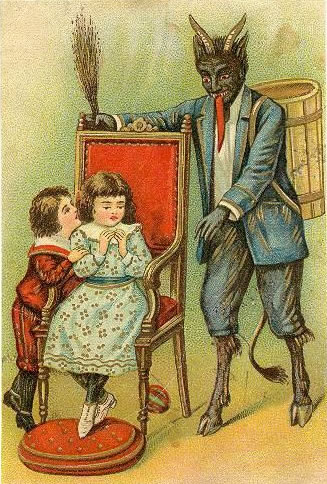
 Today is the Eve of Saint Nicholas' Day. As stated in the link noted, ...in contradiction to earlier days there should be no frightening or threatening, no putting of moral pressure on the children, especially when St. Nicholas is involved, who always interceded for the suffering and needy. Oh how the day has become wimpy!?!?
But, I won't go on here having blogged about it, with relish and a sigh of memories, here. Who needed Monster Horror Pictures with Count Floyd when you had the chain-dragging Krampus around? Let me hear and Ahhh Ohhh!(Hmm, Krampus looks a bit like Gene Simmons, doesn't he?)
Monday, July 16, 2007
Bidding Adieu (Unfortunately, not My Own)
 (Towels held down by rather large rocks on the beach of Razanac so that they're not tempted to fling themselves into the waters of the Adriatic by the famous Sirens of Hrvatska. Click on photo for larger view.)
This past weekend, we journeyed up I-295 in Jersey to see my mother off for her annual trip back to the old country. She usually leaves in mid-summer and then returns in late September so as to maximize her stay on the Adriatic Coast. She stays with the slew of relatives that all own beach houses and continually display proof that life seems much more enjoyable over there in a country still affected by the 1990's Balkan War than in this country which is constantly told to be aware of terror. While we'll be cringing behind our rose bushes searching for people intending us ill will, she'll be floating in the slightly salty waters off the coastal towns of Baska Voda, Makaraska, and Crikvenica. I am openly jealous and deliriously hopeful that our retirement down the road allows us just a bit of this easy pleasure. Days of sipping liquids on the rocks as mists of seawater brush our faces. Nights of laughter, roasting,imbibing of local cheap wine, and forgetting each night's festivities as they're replaced by the following soire. No inspection of the cork, no sniffing of the glass. Merely, the pouring of Plavac or Zinfindel into glasses of various previously intended usage. And, always, the onrush of words in various Croatian dialects, curse words delicately entwined into conversations so that emphasis of importance can be easily discerned, even through the haze of another wine bottle's opening.
I always ask my mom to take pictures. Not of monuments or statues, simply of folks and their houses and their open tables of food and drink. She rarely complies, correctly saying she "can't take pictures of continuning memories, only foggy snapshots of moments out of ocntext. So, why bother? Just come. Next year, maybe?"
To which I agree as we wave her off on her very excellent of adventures. "Next Year?"
Možda. Možda.
Labels: Croatia
Saturday, June 02, 2007
Waving to Nowhere
 The Facts:
 One 19 year old Croatian male, eyes wide-open with the possibility of making his first visit in the US of A. Note that I emphasize VISIT.
Son of my cousin, who has traveled extensively in the States, alone and with his wife, for business and for pleasure. My cousin has ALWAYS gone back to the Land of Croats. Why wouldn’t he when he’d otherwise be missing this.
This Croatian male has traveled extensively in Europe, spending months in Ireland, England & Spain. Has been, for shorter periods of time, in Italy, Germany, Austria, France, Kenya and (I believe) some of the Scandinavian countries.
Has ALWAYS returned back to home, to Croatia.
Loves to swim. Is great with kids. Enjoys his Summers, Winters, Falls, and, well I guess, Springs as well in Croatia. Who wouldn’t?
Does not have, does not want Work Visa for the US of A.
Does not have, does not want Student Visa for the US of A.
Does want to come over to work on his English; assumes this work does not require a Work Visa.
Does want to stay 45 days to work on his English and to see NYC, Washington D.C., Philly, NASCAR, and Hollywood. (may have to eliminate the latter; I don’t think he realizes that Hollywood is on the West Coast).
He’s never seen the Atlantic from this side of the world. Can’t wait to be at the beaches in Delaware and the shore in Jersey.
Not very interested in museums, but loves cars and things that move; amusement parks are high on his list of things to see.
More than happy to do volunteer work while here so that he would be immersed totally in all things American.
Does not want to / Is not expecting any remuneration. The experience is what he’s shooting for and he knows that receiving money simply complicates things.
Is 100% Croatian, although physically he resembles more your typical German kind of guy.
He’s a practicing Catholic who regularly attends Mass with his grandmother, who goes to church every day.
Oh yeah, he’s never been arrested, convicted, or jailed. He does have rather rosy cheeks, as most of his aunts and his grandmothers tend to pinch them continuously because he’s the cutest 6’ 3” kid they’ve ever seen.
The Problem
Said 19 yr old Croatian goes to US Embassy in Zagreb, Croatia for a visa interview.
A 2 minute visa interview.
Result: Rejected.
Reason: Not enough proof that he won’t stay here once entering the country.
I filled out this Affidavit of Support.
Other documentation was provided to ensure his return to Croatia.
(Not sure if pictures of the Croatian coastline, his adorable grandmothers, his parent’s house and their weekend villa on the coast, his friends, etc were provided. I am seriously thinking of getting myself adopted as a son by my cousin. I’ve been paper-trained and have outstanding table manners).
Said 19 yr old Croatian goes to US Embassy in Zagreb for a second crack at the visa.
Result: Rejected. Again.
Reason: Same as before.
The Gripe
I think that Michael at 2 Blowhards and Mr. Steve Sailer make some valid points about our current immigration policy. The US Embassy in Zagreb must be reading and applying their postings, as they seem to have taken the complaints to heart and seem to stopping any outflow to the USA from that teeny, tiny part of the world. Both Michael and Mr. Sailer discuss immigration, specifically the illegal immigration coming from Mexico and points south. I’ve read through their pieces and haven’t found anything on visitor’s visas as being a key weakness in the illegal immigration problem. They may say that the matter I’m talking about here is not an immigration issue but rather a visa issue. I disagree entirely. The two are intertwined as the State Department, perhaps due to pressure exerted by the Bush Administration or Congress, seems to think that by cutting down on visa approvals from Europe, they will be cutting down on illegal immigration. Do we have a problem with illegal immigration from Europe, specifically (getting nasty here) from Christian immigrants from Europe? I haven’t heard or read about this problem anywhere. What I have read is that life over in the EU and potential-EU countries, like Croatia, is good, pretty damn good. Folks are happy living where they already are. The Euro is much stronger than the US Dollar these days; they’re just in the frame of mind to make a VISIT here. On the cheap, well, maybe, on the cheapER.
Will we have to wait until the Dems come into office to get back to reality regarding potential visitors to the USA? Jeez, that’s another 2 years of this circle-the-wagons thinking. Maybe said 19 yr. old Croatian will have a chance to send his kids over for a visit, after he settles down, marries, and procreates. The way things are going, the shine that was so blinding which emanated from this country will be dull and lacking in uniqueness once his kids are allowed to come and to see. Not to stay.
Labels: Croatia, Only in America
Thursday, January 18, 2007
!?!?!??! Unbelievable !??!?

Can't say if this guy, Ivan Hrvatska, is even somewhat real or simply a fellow who just missed the SCTV circuit. The self proclaimed "SLAVIC LOVER, ROCKER, AND CAPTIAN OF THE CROATIAN DRINKING TEAM SINCE 2002" leaves modesty in his wake. The "discovery" of this guy is totally credited to The Fake South Shore who, I think, hits it on the head when he proclaims Mr. Hrvatksa (translated as Mr. Croatia) to be Canada's version of that Borat guy I've been in a funk about the last 2 months. Hopefully, Gospodin Hrvatska will not go into films. His self-penned songs all have the phrase "Make(ing) Love to" within their titles, overdosing one to the concept of Love in whichever forms he casts them in.
I don't think this is going to go well with the Croatia National Tourist Bureau.
Here's Ivan sending out Christmas Greetings. Never too late...or early.
Labels: Croatia
Wednesday, December 06, 2006
Hrvatski Andre 3000

(Linked from Carniola. Thanks, Michael! Source is here )
Just further proof that some guys just look fabulous irregardless of which nationality's clothing he's sporting. I'd go so far as stating that Mr. 3000 should be modeling for Croatian clothing companies more often.
How does he match a Mexican poncho with a Croatian scarf and get away with it?
(Insert appropriate word from here. Being a white guy, I'll beg off as that would be tres un-cool)
Labels: Croatia, Idiosyncracies
Friday, August 04, 2006
Fjaka

(Borrowed from diocletianvs)
An Explanation of the Philosophy of Fjaka
The story goes like this:
There was a rich American tourist staying in town. Whenever he would look through his hotel room window, there was a young man with a fish-hook sitting under a palm tree, fishing. He could see there weren't many fish in his fish pail. One day, the American decided to ask him why he wouldn't try some other place for fishing.
"Why would I go away from my house? And my palm tree?", asked the guy.
"Well," said the self-assured American," I bet you would find there are more fish outside this bay. You could catch more fish then."
The young man slowly nodded and then asked, "Why would I do that?
Well, you could catch more, not only for yourself, but...," the American pointed out, "You could also sell it on the market!
Shaking his head at the thought, the young man posed, "And why would I do that?
The American, certain he was dealing with a true lunkhead and wondering why he even tried to raise this youth's standard of living, replied "Well, one day you could buy a small boat and go to the sea where you could catch more fish."
The young man, now singing the same tune countered with another "And why would I do that?
On the edge of his last exasperated nerve, the American sighed with, "Well, you could sell it on the market. And you could get a loan. An d then buy a real fishing boat and real nets. And then, catch a lot of fish!"
Sensing the advice-giver's state of nerves, the Dalamtian flipped one more, "And why would I do that?
Oh! But this guy is thick! Must be that baking in the sun all day had fried his egg of a head. Pointing out the obvious, he said, "Well, you could finally buy a whole fleet of fishing boats. Make a huge business of it."
Once more, playing thick, the young man inquired, "And why would I do that?"
"No wonder this place is so behind the times", thought the American. "I'll have to spell it out letter by letter to this guy. "Well, you could soon become rich. So rich, you could go to a deserted place and do nothing! Just sit and rest the whole day!"
Beaming, the Dalmatian leaned back on the tree, spit itn the American's general direction and checkmated with, "Well, that’s what I’m doing right now!"
This is the concept of fjaka, which is the concept of life in Split.
The concept of fjaka tells you not to do anything that is not necessary, take a lot of rest under the palm trees or in numerous cafes. Whatever you do, make sure to stop at noon to take a real lunch. (Under no circumstance is fast food a part of a real lunch). And take a short nap after the lunch. If anyone asks you to do anything, you’re free to say, Look, "Malo sam fjakast". (I’m a little bit caught by fjaka) And this is enough reason to continue with resting.
(Note that some people you deal with in tourist offices, hotels or restaurants are not being rude to you nor especially slow as you might think at the first place. They are just living according to the concept of fjaka.)
And yes, there is a very thin line between fjaka and laziness. The trick is to dance (but not over-enthusiastically) on that line.
Labels: Croatia, Idiosyncracies
Thursday, December 22, 2005
Vrag
 Mr. Darrell Reimer discusses the "no-Santa" clause and comes up with a new word, Ag-Clause-tic to be added to everyone's lexicon. An excellent post will leave you ruminating, perhaps dregging up memories or incidents of a similar nature.simply a tangent touching the circle of his experience. A slight connection, a semblance of similarity.
Kids and myths.
Kids and religion.
Kids and large decorated talking objects.
Kids and the Christmas season.
One part, especially, of Mr. Reimer's entry struck a note:
"After all that, I’m faced with a strange turnabout in circumstance. Yesterday my oldest asked if we’d have a fire in the woodstove this Christmas Eve. I said, “Almost certainly. Why?”
“Well, I don’t want Santa to burn himself.”
Whenceforth this? Is it peer pressure? Has someone been keeping them up late, and malnourishing them to get their point across? Whatever the case, I’m getting some small notion of what it must be like for atheist parents to hear a child announce they’ve joined the Church. Like them, I’m telling myself this too shall pass….
The carefully constructed world we think we're building around our kids is continually and secretly being assaulted/affected. Our intentions may not match up with our results.
Back in the day when my nose was runny, my eyes wide-open, my hair rubbed for good luck by adults, Christmas time was a bit different. In the Socialist Republic of Yugoslavia, church-related events were wink-wink-nod-nodded. Old habits die hard and come a religious holiday, they came out of hiding, serving a multi-purpose of connecting with the past, tweeking the nose of the Socialists/Communists, and passing on the heritage to one's state-educated kids.
Costumes and outrageous makeup were de rigeur; special effects were limited to turning lights on or off.
And then there were the chains.
Santa Claus was Djed Mraz on the 25th. The Big Day for us back then was December 6th, St. Nicholas Day. At my mother's plant, the employee's children were invited, at night, to a celebration of sorts. Intentions were loving, especially in those days of central planning low wage rates. Intentions counted more than presents as the latter was in short supply even if one's parents scrimped and saved hoping to obtain said goods. Central plannning somehow mis-planned the availability of goods and I won't bother with the question of logistics. Supply/Demand was a concern only capitalists bothered with. So, the events of St. Nicholas Day were the center of a kid's holiday happenings.
I recall being herded into a large room, coats and mittens still on, with 20-30 other kids also invited for St. Nick's visit. Central planning had not counted on a cold winter so coal & oil were in short supply, well at least at the factory. As we stood by a huge decorated Christmas tree, our collective expectant breathing hung like a fog around the first tier of lighted candles clipped to the tree.
Then, the lights in the room were clicked off; only the luminescence of the tree offered us a way to see what was to happen shortly.
One kid jumped, setting off a chain reaction amongst us.
"Heard that?"
We all cocked our ears to one side, aided by our cupped gloved hands.
There it was. A scraping of metal on the steps leading up to the room. Then a heavy jangle, a dragging sound reverberating through the stairway. Slowly, too slowly, the metallic scraping became louder and louder until it stopped.
For 10-15 seconds.
The room was still dark, with the beacon of the candle-lit tree suggesting shadows somewhere off in the night.
The he jumped out, chains rattling.
Vrag!
(The Devil!)
All red he was, including his face. He stepped in amongst us, dragging several large link chains. I don't recall anything he said; my ears and throat shut down in emergency flight mode. We all screamed and looked toward our parents for help. They seemed as incapable of movement as we were. Some of us peed in our pants; the floor became slippery and a low level sulfur smell floated up from the floor. Vrag, not yet satisfied that we were terrified enough, upped the ante. He grabbed a few of the kids, lightly wrapped the chains around them and proceeded to drag them off into the darkness, shouting that he knew what they did this past year.
A new wave of screaming rose up.
The world, as we knew it, had disappeared. We must have died and not realized it. Our parents were right!
We were awful rotten little kids!
The lights flicked on. An imposing huge-chested behemoth, beard-a-flying, roared in on a stentorian voice and on a sleigh dragged by some of my mother's friends, dressed as serfs or elves or some other green & brown itchy clothed prior century type creature.
He yelled at Vrag, who promptly unchained the kids and slinked down the stairs, red barbed tail swishing against the wall.
We kids, most still in shock, tearfully mumbled our thanks. St. Nicholas, himself costumed in red, sat on a chair by the tree, as imposing and as scary as Vrag. The only difference was that the room was lit.
A bag was pulled over by his leg.
He called out each child's name (How did he know? Does he know where we live? Keys!! He must have keys! Will he come again while we're sleeping? Will Vrag precede him; he must know I lied that one time this year. It's the chains for me!)
His hands were huge, his eyes dark and piercing, weary from doing battle each year with Vrag. Those of us willing to swallow our fear in lieu of receiving a present stepped up; some preferred to be empty-handed rather than dealing with the bearded giant.
Vrag chased away, gifts distributed, he returned to his sled, stepped up, and the ill-suited workers dragged him and his sleigh away.
We went home, my sister, mother, and I (my dad was already in the States battling the likes of Kris Kringle and his henchman of HO! Ho!) and rushed to our beds where we immediately pulled the covers over our heads and waited and listened for dragging chains in the hallway.
I've recounted this story to my kids, waiting until they were in their teens. Funny thing, though. I'm convinced some experiences you have in your childhood somehow get permanently imprinted on your DNA. How else to explain one St. Nick's Day when my son cautiously descended the stairs to the living room radiator. As a family custom, we left shoes or slippers, a plate with a cookie or two, a glass of milk, and a carrot so that St. Nick and his donkey could have something to munch on when they came the night before. My son looked around, saw the cookie, half-eaten (Nick was on a diet (unsuccessful, I'll add) that year) and the glass, drained. The carrot was all gone save for the greenish top (picky eater, that donkey!).
He screamed!
"How did he get in??!?"
"Does he have keys?!?"
"...Or is he like a burglar, sneaking around while we sleep?"
A familiar pang shot through my heart. A cold sweat came on. Oh, those happy holidays.
Labels: Croatia
Thursday, November 17, 2005
Looking up
 A piece by Michael Manske of The Glory of Carnolia and San Diego Reader fame recently on Self-Esteem and Suicides is worth a visit. Some professors at Bradley University concocted a survey and proceeded to draw conclusions on the results, based on the scores of each particular country. The subject was self-esteem. Mr. Manske then ties in suicide rates, globally speaking.
This little post starting a wee bit of reminiscing on my part. Back to the days when I was a 7th grader in the old Croatia, when it was still Yugoslavia.
I was back in the Old Country for a year’s worth of education so that the Croatian that I had so quickly and shamefully forgotten when we first came to the states could be recovered. My (ultra-limited) natural abilities for learning to speak a language combined with the difficulty of this particular language, with its rules and counter-rules (Learning Croatian being akin to learning to playing the violin with one’s feet while sitting on a wood-burning stove) made for quite an interesting year. “Interesting” as in that old Chinese curse, “May you live in interesting times.”
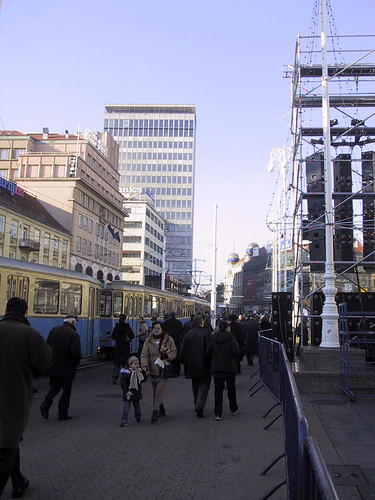
We shuttled between various relatives in the short year that we were in Zagreb. For a short while, I lived with an aunt just off of the central square, nowadays called Jelicic Plac (Jelicic Square). Her apartment was in a 6 story building fairly close to the tallest building in the city, its first skyscraper. That building was called the Neboder, which is the Croatian word for skyscraper. Since there were no other skyscrapers in the city, this building became The Skyscraper. Even after other taller skyscrapers went up, they were called "neboder" rather than "Neboder".
During my short stay with this wonderful aunt and her family, living in the center of the largest city in Croatia offered a continuous stream of happenings. From Monday through Saturday, I'd take the tramway from the square to my grammar school in another part of the city. The tram stop was less than 1 block from my aunt's building, so I tended to cut it close as far as catching the #9. Sometimes, I'd miss it, because the usual stop was closed off and I'd have to walk quite a few blocks to catch another streetcar. The main reason the stop would have been closed was that a body was on the street.
Someone had jumped from the Neboder.
The relatives tell me that was the worst year for suicides, specifically for jumpers. Those who ventured up to the roof of the Neboder were said to be in for the Duboki Pad (Deep Fall). After a while, the management of the Neboder caught on that it wasn’t good for business to have people regularly jumping from your building, so guards and locks were implemented. A determined person could still make their way through. For others, the alternative would be the surrounding buildings. Shorter versions of the Neboder. These deaths were called the Plitki Pad (Shallow Fall). The block on which the Neboder was located was packed with shorter versions of the original, all together forming a wall edging the four sides of that block. In the center of this block was empty space. A locked in sound amplification area. Sometimes, a jumper would not throw themselves onto Ilica, the main street. They would go to the other side of the skyscraper and throw themselves into the enclosed space. On such an occasion, if the window in the kitchen or in my bedroom were open, I’d hear a boom and I’d know someone had jumped.
"Pogledaj gore" (Look up) became the phrase for the morning salutations as we left for school. Supposedly, one pedestrian was almost killed when a jumper landed very closely to them one morning. In kid-dom, the "almost" quickly became the "certain" and we began our mordant math on the number of deaths so far. Since I was one of my only classmates who commuted from downtown, I was expected to provide the gory details of any death. This worked out fine, since I never saw anyone; I was usually asleep or in class when someone died. But on one morning, I came out of our building shortly after someone had landed on the main street. The body was already covered with copies of that morning's paper and with someone's coat. Blood was pooling around the person, with a bright red rivulet running into the black steel tram tracks. A younger woman, one of the municipal cleaners, was brushing the flow with her long twiggy broom. I could see tears rolling off her cheeks and mixing in with the blood of the jumper. This must have been her first incident. Later that year I came upon a similar situation, but the cleaning woman, an older stockier version, wore a blank expression as she hurriedly swept the street. The sharp rasp of her broom echoing in the street. I stopped providing any descriptions after that, ashamed of the attention given to me by someone's tragic death.
My aunt lived on the third floor of her apartment building. The staircase wending its way through the building was broad and the steps short. One could easily take two steps at a time which meant a typical teenager could take three. The steps were finished with an Adriatic blue ceramic tile, a bit slippery after a rain or snow fall. Because the steps were so short and the tile so slippery, when coming down one could slide down by taking a running start. Coming home, one could seemingly fly up the stairs, bounding up through the building.
There was an iron gate at the foot of the stairway, requiring a key. While fumbling through one's pockets for the key, someone may be exiting the elevator. It was then easier, though slower, to take the lift than to keep on searching for that key.
One day, coming home later from school, I found myself tearing through my pockets for the keys for the gate to the stairway. That keychain also held the keys to the elevator, which one needed to get onto the elevator unless someone was exiting as you were hoping to enter the elevator car. Out of the corner of my eye I noticed a tall shadowy figure. It wasn’t odd to see someone just moseying around the lobby, especially in the colder months of the winter. Someone may be waiting for a friend, a tenant in the building to come down so they can go to one of the 4 or 5 kavanas (coffee houses) in the immediate area. Or, someone may just duck in to get a bit warmed up from the bitter blowing outside. I didn't recognize this man as one of the regulars, so I assumed he was there for a warm-up.
As I was still digging through my pants for the keys, the lights of the elevator stopped counting down. A tenant from the top floor got out, looked at me, swirled the top of my hair as was the wont of most older folks, smiled, and held the elevator door open for me. I went inside and, just as the door was shutting, found myself in the small elevator car with the shadowy stranger.
He slipped in and leaned, slightly, on the far wall. He was about 6’ 2” but seemed taller because of his gauntness. Though he seemed to be using the wall to support him, he stood ramrod straight, his cloudy eyes staring straight ahead, his hair, grayish tinged black, standing resolutely high and straight.
The dignity he bore was, alas, not reflected in his suit. The fine cut, the crisp cloth, the tightly sewn and aligned buttons. All were now gone, the well-dressed spirit had deserted the cloth. Only his posture, now stark due to his skinniness, remained, a faint reflection of what must have been an impressive gentleman.
I punched "III" on the control box. From his position, he extended a long arm and scraped on "VI". I peeked over. I knew who lived on the sixth floor; his face was a new one attached to that floor. I continued to busily go through my pockets, just an activity to keep me engaged in my own solitude and a siganl to him to stay in his.
"Nice day", he said in a high and airy voice.
I mumbled some acknowledgement and pressed "III" over and over again, all the while knowing this would not make the elevator go any faster.
"It’s cold but it’s a fine purity. A clean day for flying",
What? Did I hear that? I faked a coughing attack.
"Are you o.k.?"
I nodded, excessively, if I recall correctly.
We reached the third floor. I hurriedly pushed the door open and grabbed my schoolbag.
"Good bye, son".
It was the loneliest sound I’d ever heard.
The elevator door closed and started its ascension to the 6th floor. I rushed to my aunt’s door, keys at the ready. Quickly opening the door, I went directly to my bedroom. I cracked open a window slightly, so I could hear...anything. An hour or two passed with no booms. I walked to the living room, where windows offered a view of the entire square. I pulled the long drapes back, swung the casements windows in, and leaned a bit over the window ledge.
No trollies were stopped.
No crimson on the street below.
I stuck my head out and looked up.
There he was, his head poking out from the tip of the flat roofline, hair still perfectly vertical. He saw me after a while and waved a fluttery good-bye.
Tuesday, August 16, 2005
Village Life
 "No, not those ones", he pointed to a box of cigarettes with the warning label (loosely translated), "May inhibit your potential and affect your growth".
 "The other ones...the ones with the "Proven by Science to kill you" label."
I was standing next in line, waiting to buy a paper and 3 liters of 2.8% milk. He threw down some money and ripped off the cellophane from the box with his deeply-tanned spidery fingers.
While waiting for his change, he thumped the box hard on the counter.
"Gets all that cancer down toward the tip of the cigarette", he offered as reason and advice.
He proffered a cigarette. I delicately refused. He gave me that rueful look only a smoker can come up with when dealing with a non-smoker. That look that carried a "Think you’re living longer than me?!" tone to it. Fire somehow appeared in his cupped left hand and he lit the butt he'd slipped into his mouth. He blew me the balance of his first drag. He gives me the once-over, bushy brown-blonde brow, a ledge over his piercing blue eyes.
"Milk?" As in, "What else could you expect of a non-smoker but the juice of a cow?". He excused himself. We didn't know each other but we knew we'd be seeing each other again and that would be shortly in this village.
It's a small place. You buy a cone with two balls of gelato (winter berry and stratiacella) at one end of town and you're finished and yearning for balls of tiramisu and hazelnut gelato before you're ¾ of the way through the village. Since your car hasn't moved since you'd arrived and walking is the most efficient way to get around and you are burning calories with your walking, well... a short bout of self-deception and you simply turn back to reload on the ice cream.
The village sits on the Adriatic at the bottom of a precipitous drop of the Biokovo mountain range. A tiny harbor runs the length of the village; some smaller fishing boats are anchored in chest-high waters. The water is clear and ranges from a hint of blue at beach's edge to a shimmery turquoise and finally to a dark blue where the depth drops off to 70 meters. There used to be a winding dirt road running down from the main highway. More like a trail, as it wasn't wide enough for two cars. Rather than setting an alternate and more logical course, the modernization of the road is evidenced simply by an asphalt coating of the trail. Some houses are right on the road. On the road. Evidence of late-night inebriated drives down to the village are seen in the missing chunks of the houses' wall corners. Sleeping in some of these bedrooms must require an absolute faith in your fellow man's reactions and their vehicles' turning radius. That or a few belts of rakija before you retire for the night.
The villagers and the tourists generally seem to know each other, like Alaskan grizzlies are acquainted with returning salmon. There's no biting, well at least not of the physical sort. You'll hear an occasional "Joj" or "Achhh", from the konobas (restaurants) parked on the beaches, as newly minted arrivals gape at the menus and take in the summer prices. So economic bites are being taken, at least from mid-June to late August. However, for most of the tourists there, surprises are minimal. They've been coming to this place for the past 10-15 years, so the uncalled for surliness of some of the villagers is not a surprise, simply an expected character flaw of this village. They shrug at the unkindness shown them and gaze out over the beach to the water and breath in the salty air sighing that it's all worth it, even with the lack of politeness. The villagers know their livelihood depends on these folks coming back. They jack up the prices for three months, counting on this one quarter's worth of income to carry them through the balance of the year. If it's possible to switch ambition on and off, it's proven here each summer. And yet, this sometimes uncivil behaviour toward your bread ticket strikes me as truly bizarre. The year-long residents act as if they're superior to their guests who are leagues away richer and more educated than them. In some ways, the villagers are having their cake and eating it too. And the tourists aren't complaining, well at least not loudly.
An aunt of mine has been coming here for well over 40 years. She has a house there, deliberately built by her husband with only village labor. Buying her food from the over-priced market, doing favors for the villagers, assisting them in their forays with the government, and having paid various villagers more than was honestly necessary to build the house would seem to qualify her for a full embrace into this village. And yet, she's still considered an outsider, although grudgingly approached when a favor is needed. Conditional inclusion.
It's an early weekday morning. The sun's been heating the house since about 5:30, waking us from a moonlit sleep. My cousin and his visiting friend invite me to their "office" for a morning cocktail. We slip on bathing suits, slap on some SPF 15 and scrape ourselves down to the village.
A couple has already toweled off a prime location on the beach. He's on his cell phone announcing his beach claim. His wife is lying face down, top off, feet barely touching the lapping water. Off the phone, he yells at his wife to "get me some tan." Her arm floats around the small rocks searching and finding the Nivea bottle, which she throws in his general direction. He picks up the bottle, takes five steps up the beach and parks himself in a café chair. A cappocinno’s in order.
The three of us slip by his table and make the short trip on the rocks shielding the road out of town. About 100 meters and we're at my cousin's "office", The Sahara Bar. Music's playing, softly at first, then escalating. Afro-Cuban All-Stars. "Amor Verdadero", Puntillita on lead vocals. Croatian beach. Belgian beer. Cuban music. It’s a sumptious fit.
Monday, August 15, 2005
Balkan Surprise
An article from the July 2005 Outside Magazine issue, written by a recent Cambridge University Masters of History grad and frequent Outside magazine contributor, Tim Sohn offered an excellent outsider's view of the beloved homeland. Here's the full article.
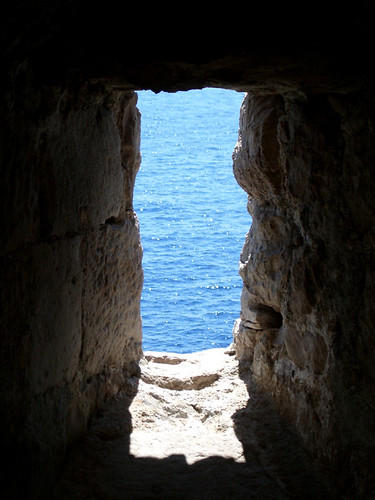 Reprinted from Outside Magazine
Balkan Surprise
by Tim Sohn
Welcome to Croatia, the melting pot of hot. Where East meets West, the old is new, the young are worldly-wise, the wilds are pristine, and the 20th-century shadows of war are giving way to a hip and happening 21st-century place to find peace.
by Tim Sohn
"IT'S NICE, NO?"
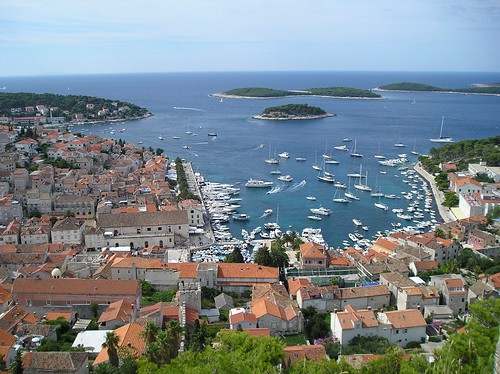
Tonci Lucic, my tall, scruffy, Game Boy–addicted host on the Croatian island of Hvar, is a disembodied but smiling head bobbing to the rhythm of the surf as we tread the warm cobalt water of the Adriatic. Above us, a 16th-century castle watches over a medieval town whose flower-bedecked alleys were laid out centuries ago by Venetian nobles. Just offshore, the Pakleni Otoci ("Satanic Islands") are visible, green hills jutting up through the placid water like a partially submerged Jolly Green Giant asleep in a tepid bathtub of electric-blue Kool-Aid.
Yes, it's nice.
"We usually swim every day, sometimes two times a day," Tonci tells me.
The Dalmatian island of Hvar is the sparkliest star in the thousand-plus-island constellation that sits in fixed orbit off Croatia's 1,104-mile Adriatic coast, a thin sliver of lavender-covered hills tumbling down to secluded coves where swimming is less a choice than a pleasant obligation.
I first met Tonci, a 30-year-old martial-arts enthusiast, skateboarder, and sometime innkeeper, because his wife, Teja Dittmeyer, looks fantastic in spandex. Toward the end of my first trip to Croatia, a ten-day early-autumn barnstorming of the Dalmatian coast, I disembarked from the ferry in the town of Hvar to the welcoming sight of a woman I inferred, from her blond pigtails and shrink-wrapped jogging outfit, to be a Swedish yoga instructor. She was an oasis of hot amid the mob of kindly-looking old women who typically greet travelers at docks and bus stations, offering rooms for rent in their quaint homes. I had come to rely on such offers for lodging, but somehow, on that day, the spandex was a stronger sales pitch. It wasn't until Teja handed me off to Tonci and went in search of other customers to install in their tastefully renovated, centuries-old stone house that I realized I'd been the victim of a classic bait and switch, but one that would prove yet again how skillfully the fates of Croatia traffic in the happy accident.
Over the course of that first trip and a subsequent four-week journey, I traveled by boat, bus, train, scooter, bike, car, kayak, foot, and donkey. I spent a morning hiking in the hills above Dubrovnik and still made it back to the beach for a lazy afternoon swim. I walked through the remnants of Roman palaces and Napoleonic forts and visited cathedrals and museums and castles. I walked mountain trails and poked my head into limestone caves and gazed out over former minefields. I ate Italian food as good as any I've had in Italy and heard my voice echo through the empty concrete caverns of decommissioned Yugoslav missile silos.
By the time I emerged from my swim that day, Tonci was wearing boardshorts and a baseball cap and was already fiddling away on his Game Boy. His feet were propped up against a fading row of cinder-block cabanas, while his dog, Hajdi, lolled at his side in the warmth of one of the island's 300 or so days of annual sunshine. The whole tableau belied Tonci's true identity as a budding tourism mogul.
"This year, we have two rooms and two boats to rent," he told me, pausing the game to elaborate his business plan. "Next year, maybe four rooms and four boats, and then little by little we grow bigger and save money and then maybe we build our dream place." As he described this solar-powered, self-sufficient lodge complete with organic farm, art gallery, and skateboard halfpipe, I entertained a small fantasy: I would pack up my life, move to Hvar, and help him build it—in exchange for my own hammock, perhaps.
"But for now," he said, putting down the Game Boy, flashing a big smile, and cutting my daydream short, "let's go for a swim."
GIVEN THE TENDENCY of disaster zones to be nudged off world television screens and into obscurity once the disaster abates, the average American might still have trouble finding this small, horseshoe-shaped Balkan nation of about 4.5 million people on a map. They would probably have more success conjuring a CNN-derived mental picture of the Balkan conflict of the early 1990s. Since the war ended, in 1995, Croatia has become increasingly democratic, moving toward economic recovery and integration with the rest of Europe.
The integration has been happening, on a more informal level, for the past decade as savvy European travelers have rediscovered this former playground of the Central European elite. In 2004, 7.9 million foreign visitors arrived in Croatia, an amazing rebound from the 1995 postwar nadir of 1.3 million. Tourism has become the golden-egg-laying goose of the sagging Croatian economy, accounting for 23 percent of Croatia's GDP and 27 percent of its total employment.
The first tourists to return were the Austrians, Germans, and Italians, the neighbors who had historically made up the bulk of the nudists and fashion plates who flocked to the resorts of the Adriatic coast. Lately there have been more Scandinavians, French, and Brits as word has spread that, for a country smaller than Maine, there's a hell of a lot more to do here than get a tan.
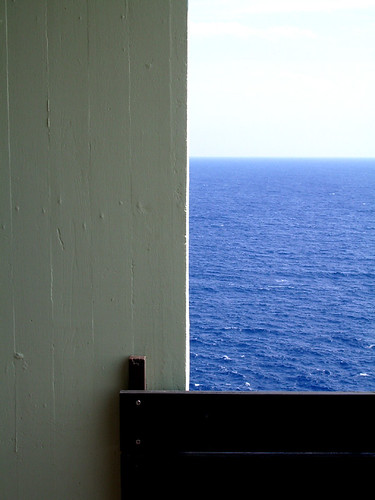 The obvious advantages of the Latin-infused coastal regions—most of the coast was once part of the Roman Empire and later fell under the sway of Venice—have long made it a favorite of sailors, divers, and fishermen, and that roster has grown to include sea kayakers, windsurfers, and paragliders. And from the Istrian Peninsula in the north through the Dalmatian coast and islands to Dubrovnik in the south, the region's karstic geology has produced a stunning array of cliffs, peaks, and caves. Northern Velebit, Paklenica, and Biokovo parks are all prime pieces of waterfront real estate, offering hiking, climbing, caving, and camping, while the Cetina River, one of several southern Dalmatian waterways, has become a popular Class III–IV whitewater run. Though the Germanic-tinged north is better known for its fairy-tale hilltop castles, there's plenty of hiking and biking to be had in the Zagorje region, north of Zagreb—plus a good lager or wurst is never far off. And almost everywhere, you'll be offered strong Turkish coffee, a reminder that during the 16th century the thin line between Western Europe and the expansionary tendencies of the Ottoman Empire ran through Croatia.
As the rediscovery of Croatia has gathered steam, the European press has dabbled in some selective rebranding. The coast has been called the "New Riviera" and Dubrovnik the "New St. Tropez"; the Istrian Peninsula, close to Italy, has been labeled a "New Tuscany"; and Zagreb has, like every other good-looking but peripheral Central or Eastern European capital, been dubbed a "New Prague." And all of this glamour is not without precedent: A little hype is nothing new on a coast that once hosted vacationing Hapsburgs and cultural luminaries such as Gustav Mahler, Vladimir Nabokov, James Joyce, and Anton Chekhov. The tabloid-worthy roster of recent visitors includes Steven Spielberg, John Malkovich, and Andre Agassi; Tom Cruise's yacht reportedly docked off of Hvar last year; and Clint Eastwood and Robert De Niro are rumored to have shopped for their own private islands.
What's old, it seems, is new again.
THOUGH NOT COMMONLY recognized by economists as an index of affluence, sunglasses seem to me as able a barometer as any of a city's relative prosperity. Strolling the streets of Zagreb, Croatia's stately capital of 800,000 people, on a sunny Saturday morning, wearing normal prescription eyeglasses, I felt naked, exposed as a foreigner. Drawn toward a dull roar of eager conversation, yapping lap dogs, and laughing children, I wound up on Tkalciceva, the wide pedestrian thoroughfare between Kaptol and Gradec, the two ancient hills that flank the city's historic center. The outdoor café tables were filled with the sort of earnest capitalists, hip young people, and occasional slick-haired gangstrepreneur who constitute the new bourgeoisie of many post-communist cities, and at every table, evidence of the city's resurgent postwar fortunes sat astride their noses. These promenading locals viewed their lives through Armani, Dolce & Gabbana, Gucci, and Prada lenses.
It's not just sunglasses: The BMWs, Audis, and Benzes, the cell phones, the iPods, and the new office blocks all bespoke a city on the rise. But even as I toured modern-art galleries, partied at swank clubs to records spun by Italian DJs, flipped through the Croatian translation of Bill Clinton's autobiography (Moj Zivot) at a local bookstore, and drank coffee with Croatian students eager to correct my misconceptions about their nation, the past was never far off. Colliding with all this newness, the city's grand buildings, wide boulevards, exquisite churches, and fine museums imbue it with the dignified feel of Vienna and the lost grandeur of Mitteleuropa.
That such cosmopolitan urbanity both exists in Croatia and mingles freely with the country's pastoral charm does not surprise Croatians; what surprises them is how slow the rest of the world has been to catch on. While the continuing reliance on small-scale fishing and agriculture is everywhere visible, any Croatian schoolchild can tell you that his country is the birthplace of various Roman emperors, inventor Nikola Tesla, the modern necktie, and the mechanical pencil. Lately, it has been their sporting heroes who have brought Croatia back to the world's attention, from Janica Kostelic tearing up the World Cup skiing circuit to Ivan Ljubicic leading a team of tennis upstarts in taking down the U.S. Davis Cup team this past winter.
And recently, eager males the world over have been heard uttering the same phrase: "I hear the women in Croatia are hot." Indeed.
Famed for its charming, set-piece beauty, Dubrovnik seemed an appropriate backdrop for testing this rumor. This seaside city of 30,000 people punctuates the coast and is centered around a historic walled core that's been designated a UNESCO World Heritage Site.
Its car-free corridors and imposingly uniform stone buildings serve as reminders of the maritime-derived wealth amassed between the 15th and 17th centuries. Though besieged and shelled by Serb forces in 1991, the proud city has reclaimed its former role as a magnet for the chic and glamorous.
One night last fall, an English friend and I fell in with the crowd promenading along the Stradun, a pedestrianized artery occupying what was once a channel separating the island of Laus from the mainland. We eventually migrated to a narrow, cobbled alleyway, an archaic space crammed with smartly dressed young people, the overflow from several dimly lit bars. Choosing one at random, we squeezed into the small entryway just inside the door, only to be ambushed by an impenetrable wall of hotness—in front of us, packed like sardines in a can, was a sea of leggy, sharp-featured women whose glowing eyes sized up our disheveled exteriors and dismissed us in the same nanosecond. It is likely that these women spoke perfect English. Unfortunately, we never found out: Having embarrassed ourselves by doing everything short of rubbing our eyes in disbelief, we beat a retreat to the alley and ordered beers from a passing waiter.
"Wow. Stunning," said my friend, Howard, after we'd exited the unnamed bar and caught our breath. Later, in our numerous retellings of the incident, it would become known as "the Honeypot."
When I returned to Dubrovnik four months later, the seasonal crowds had mostly gone, and, with them, the nightlife. When I tried once again to locate the bar of plenty, I could not. But there were still gleaming BMWs alongside ailing Yugos, ancient rowboats berthed next to million-dollar yachts in the marina. And I did meet Esme, a soft-spoken middle-aged woman who rented me a beautiful studio apartment just off the Stradun for $15 a night. On my last evening, as I stood high above the city on top of the ruins of a fort built by Napoleon and watched the sun set over the red-tiled roofs and the Adriatic beyond, I didn't really miss the Honeypot.
But if I go back to Dubrovnik, I might try to find it again.
"THERE ARE NO new things on this island," declared Pino Vojkovic, 29, the ponytailed founder of an adventure travel agency called Alternatura, as we stood atop 1,926-foot Mount Hum, the highest point on his home island of Vis. Surveying this remote Croatian isle, about 15 miles west of Hvar, I thought it looked like a place that would make a fine hideout for a Bond villain—craggy, remote, mountainous, and riddled with caves.
"Everything here is a little... sleepy," Pino told me, and, after two days of being lulled by its slow-motion pace, I had to agree.
Still, he had just finished telling me that he and his paragliding friends liked to jump off the spot we were standing on, catch the rising thermal draft, and soar out over the water before gliding down to his hometown, the fishing village of Komiza. He had shown me a video of it that morning on his laptop, telling me that his agency organizes a paragliding festival every December and that he offers sea-kayaking, trekking, scuba-diving, and boat trips to nearby islets. Surely these things must qualify as novelties on an island of farmers and fishermen that was closed to outsiders until 1990 due to its strategic importance as a Yugoslav military base. And even Pino himself is the embodiment of something new.
"Another way of tourism is becoming more popular: outdoor trips, adventure, aromatherapy... and I don't know what," Pino told me, trailing off and chuckling to himself, seemingly over the prospect of aromatherapy. "But our government and bureaucracy are very afraid of new things. They are stuck in the old way, so they do not see this yet, but soon they will have to."
Zeljko Kelemen, 52, the elder statesman of the Croatian outdoor scene, has been instrumental in helping people understand the potential of adventure tourism in Croatia. A former competitive kayaker, he now owns Croatia's oldest and largest outdoor outfitter, Huck Finn Adventure Travel. In the early 1990s, Zeljko began offering a few rafting trips that drew a steady clientele of UN peacekeepers.
"The biggest problem we have is adventure illiteracy," Zeljko told me in his storefront office on the south side of Zagreb, his new VW van parked outside with two yellow kayaks on top. "Most people have no idea what is caving, kayaking, canoeing, rafting.
"When we first started with sea kayaking near Dubrovnik, the locals saw us and said, ‘These must be poor people who have no money to pay for a nice motorboat,' " he recalled, "but gradually they realized that even though our clients are in kayaks, they are eating at the best restaurants, they are spending money, and then it started changing their idea of adventure tourism. It just takes time."
And though it needs a little more time to ripen, the Croatian outdoor scene is coming of age. For example, visitation to Paklenica National Park, a popular rock-climbing and hiking area midway down the Dalmatian coast, has increased from 30,000 visitors in 1990 to 105,000 in 2004. While the first adventure race drew only blank stares five years ago, there are now ten or so annually. And the tourist board's adventure travel brochure listed 40 agencies offering outdoor trips in 2001; by 2004, that number had grown to 120. By virtue of his expertise, contacts, and experience, Zeljko sits at the apex of this nascent network of outdoor operators—but not everyone gets what the younger generation is trying to do.
On my final morning in Komiza, on the island of Vis, I sat in a smoke-filled café with Pino and his childhood friend and business partner Zvonko Brajcic, 29, known universally as Dado.
"Here, if you are young, the older generation thinks you don't know too much, and so they don't give you the opportunity, and the banks won't give you loans," Dado said. "So the only capital we have is our enthusiasm and our ability to work."
"Enthusiasm," interjected Pino with a snort, venting a bit of his frustration at having to turn his office into a video-rental shop during the winter months to make ends meet. "Now it is all enthusiasm and not enough doing, but we cannot eat enthusiasm."
As I was leaving to catch a ferry back to the mainland, Dado produced an apt parable.
"The boats in Komiza," he told me, "were always painted black. Then one guy a hundred years ago painted his white, and the others laughed. But then they saw that he sleeps well and is not so hot and they did the same. Now all the boats are painted white—and this is how new ideas go here: very slowly."
AFTER WEEKS OF GOING very slowly myself—lazily sipping espresso at café tables, lapping up the drowsy pace of island life, and too frequently accepting offers of home-brewed alcohols—I was in no shape for a hike.
Of course, by the time I realized that, I was following three fit Croatians up a stone path heading toward a mountain hut in 23,722-acre Paklenica National Park, whose 90 miles of hiking trails are less than an hour from the coastal city of Zadar. The path followed a sparkling stream overshadowed by Croatia's fourth-highest peak, Vaganski, a 5,767-foot limestone outcrop. We were sandwiched by soaring limestone walls spackled with the bolts of some of the 500-odd sport-climbing routes that drew 40,000 climbers last year.
As we walked, my three guides—Marijan Buzov, 30, a national-park ranger who recently started an outfitting business; his wife and business partner, Irena, 28; and their 33-year-old friend Jana Mijailovic—all members of the Paklenica Mountaineering Club of Zadar, explained the development of the Croatian outdoor scene while their dogs, Dingy and Frodo, flitted in and out of sight.
 "Ecology was not a word we knew in the old system," Marijan explained, "but our natural environment is the one good thing we have left from communism: We didn't have the money to destroy our nature, so we have that—clear water, beautiful parks and mountains—and it makes us competitive with other Mediterranean countries."
When we arrived at the hut two hours later, my guides began to extract onions, potatoes, cheese, ham, salami, baguettes, a whole chicken, and two six-packs of beer from their packs. I was doubly shamed, as mine contained little more than a notebook, a camera, a sleeping bag they had lent me, and some lint. Luckily, the hut was a well-provisioned two-story affair of brown logs, gray stones, and red shutters, with a smoking chimney and laundry fluttering on a clothesline strung across the second-story porch.
Inside was a square card table in front of a woodstove where four men of varying ages sat and played dice while drinking a constant stream of dark coffee and smoking an equally steady supply of cigarettes rolled from a shoebox full of loose tobacco. The ringleader of their typically operatic Croatian conversation, who was also the hut's caretaker, resembled a cross between Walt Whitman and Charles Manson, a smallish man with a quick smile and a kindly face framed by a graying goatee and a rat's nest of shoulder-length salt-and-pepper hair. He wore slippers even when venturing outside to fetch firewood or check on the water-wheel that powered the hut's few dangling lightbulbs. Occasionally, he took a moment out from the table to talk to his dog, and one could be forgiven for thinking he was asking her advice on some finer point.
"They look crazy," said Jana, nodding toward the table when she saw me looking at them. By then we were eating a delicious meal that she'd prepared for us by burying a Dutch-oven-like dish called a peka in the coals of the smokehouse outside for half an hour. "But they're really not."
As if on cue, the men broke into a chaotic song that mirrored their conversation, which was itself a well-practiced four-part harmony of shouting and laughing, gesticulating and knee slapping. It looked and sounded exhausting and seemed a validation of what I had come to see as the indivisible trinity of Croatian-male life: coffee, cigarettes, and conversation.
"What are they talking about?" I asked, expecting tales of sorrow, passion, ideals, politics, humor, or perhaps sports.
"Nothing, really," replied Irena.
The next morning, Marijan and I sat outside the hut at a picnic table, drinking coffee and discussing the past, present, and future of Croatia as the sun rose above us and illuminated the peaks higher in the valley. The dice players of the evening before had set to work clearing a nearby hillside of brush, stacking what they'd cut into big piles to be burned later. Their working pace seemed regulated by the same metronomic beat as their dice game: a few minutes of concentrated work followed by a cigarette break, during which they took their shirts off, sat in the sun on rocks and stumps, and resumed their conversation. I kept one ear on them as Marijan talked, but his purposeful English won out over their jolly mayhem.
"You know what's the really good thing about Croatia?" asked Marijan, surveying the scene while taking a long drag from his cigarette and offering me one. "People can still be surprised here."
Reprinted from Outside MagazineBalkan Surprise
by Tim Sohn
Welcome to Croatia, the melting pot of hot. Where East meets West, the old is new, the young are worldly-wise, the wilds are pristine, and the 20th-century shadows of war are giving way to a hip and happening 21st-century place to find peace.
by Tim Sohn
"IT'S NICE, NO?"
Tonci Lucic, my tall, scruffy, Game Boy–addicted host on the Croatian island of Hvar, is a disembodied but smiling head bobbing to the rhythm of the surf as we tread the warm cobalt water of the Adriatic. Above us, a 16th-century castle watches over a medieval town whose flower-bedecked alleys were laid out centuries ago by Venetian nobles. Just offshore, the Pakleni Otoci ("Satanic Islands") are visible, green hills jutting up through the placid water like a partially submerged Jolly Green Giant asleep in a tepid bathtub of electric-blue Kool-Aid.
Yes, it's nice.
"We usually swim every day, sometimes two times a day," Tonci tells me.
The Dalmatian island of Hvar is the sparkliest star in the thousand-plus-island constellation that sits in fixed orbit off Croatia's 1,104-mile Adriatic coast, a thin sliver of lavender-covered hills tumbling down to secluded coves where swimming is less a choice than a pleasant obligation.
I first met Tonci, a 30-year-old martial-arts enthusiast, skateboarder, and sometime innkeeper, because his wife, Teja Dittmeyer, looks fantastic in spandex. Toward the end of my first trip to Croatia, a ten-day early-autumn barnstorming of the Dalmatian coast, I disembarked from the ferry in the town of Hvar to the welcoming sight of a woman I inferred, from her blond pigtails and shrink-wrapped jogging outfit, to be a Swedish yoga instructor. She was an oasis of hot amid the mob of kindly-looking old women who typically greet travelers at docks and bus stations, offering rooms for rent in their quaint homes. I had come to rely on such offers for lodging, but somehow, on that day, the spandex was a stronger sales pitch. It wasn't until Teja handed me off to Tonci and went in search of other customers to install in their tastefully renovated, centuries-old stone house that I realized I'd been the victim of a classic bait and switch, but one that would prove yet again how skillfully the fates of Croatia traffic in the happy accident.
Over the course of that first trip and a subsequent four-week journey, I traveled by boat, bus, train, scooter, bike, car, kayak, foot, and donkey. I spent a morning hiking in the hills above Dubrovnik and still made it back to the beach for a lazy afternoon swim. I walked through the remnants of Roman palaces and Napoleonic forts and visited cathedrals and museums and castles. I walked mountain trails and poked my head into limestone caves and gazed out over former minefields. I ate Italian food as good as any I've had in Italy and heard my voice echo through the empty concrete caverns of decommissioned Yugoslav missile silos.
By the time I emerged from my swim that day, Tonci was wearing boardshorts and a baseball cap and was already fiddling away on his Game Boy. His feet were propped up against a fading row of cinder-block cabanas, while his dog, Hajdi, lolled at his side in the warmth of one of the island's 300 or so days of annual sunshine. The whole tableau belied Tonci's true identity as a budding tourism mogul.
"This year, we have two rooms and two boats to rent," he told me, pausing the game to elaborate his business plan. "Next year, maybe four rooms and four boats, and then little by little we grow bigger and save money and then maybe we build our dream place." As he described this solar-powered, self-sufficient lodge complete with organic farm, art gallery, and skateboard halfpipe, I entertained a small fantasy: I would pack up my life, move to Hvar, and help him build it—in exchange for my own hammock, perhaps.
"But for now," he said, putting down the Game Boy, flashing a big smile, and cutting my daydream short, "let's go for a swim."
GIVEN THE TENDENCY of disaster zones to be nudged off world television screens and into obscurity once the disaster abates, the average American might still have trouble finding this small, horseshoe-shaped Balkan nation of about 4.5 million people on a map. They would probably have more success conjuring a CNN-derived mental picture of the Balkan conflict of the early 1990s. Since the war ended, in 1995, Croatia has become increasingly democratic, moving toward economic recovery and integration with the rest of Europe.
The integration has been happening, on a more informal level, for the past decade as savvy European travelers have rediscovered this former playground of the Central European elite. In 2004, 7.9 million foreign visitors arrived in Croatia, an amazing rebound from the 1995 postwar nadir of 1.3 million. Tourism has become the golden-egg-laying goose of the sagging Croatian economy, accounting for 23 percent of Croatia's GDP and 27 percent of its total employment.
The first tourists to return were the Austrians, Germans, and Italians, the neighbors who had historically made up the bulk of the nudists and fashion plates who flocked to the resorts of the Adriatic coast. Lately there have been more Scandinavians, French, and Brits as word has spread that, for a country smaller than Maine, there's a hell of a lot more to do here than get a tan.
The obvious advantages of the Latin-infused coastal regions—most of the coast was once part of the Roman Empire and later fell under the sway of Venice—have long made it a favorite of sailors, divers, and fishermen, and that roster has grown to include sea kayakers, windsurfers, and paragliders. And from the Istrian Peninsula in the north through the Dalmatian coast and islands to Dubrovnik in the south, the region's karstic geology has produced a stunning array of cliffs, peaks, and caves. Northern Velebit, Paklenica, and Biokovo parks are all prime pieces of waterfront real estate, offering hiking, climbing, caving, and camping, while the Cetina River, one of several southern Dalmatian waterways, has become a popular Class III–IV whitewater run. Though the Germanic-tinged north is better known for its fairy-tale hilltop castles, there's plenty of hiking and biking to be had in the Zagorje region, north of Zagreb—plus a good lager or wurst is never far off. And almost everywhere, you'll be offered strong Turkish coffee, a reminder that during the 16th century the thin line between Western Europe and the expansionary tendencies of the Ottoman Empire ran through Croatia.As the rediscovery of Croatia has gathered steam, the European press has dabbled in some selective rebranding. The coast has been called the "New Riviera" and Dubrovnik the "New St. Tropez"; the Istrian Peninsula, close to Italy, has been labeled a "New Tuscany"; and Zagreb has, like every other good-looking but peripheral Central or Eastern European capital, been dubbed a "New Prague." And all of this glamour is not without precedent: A little hype is nothing new on a coast that once hosted vacationing Hapsburgs and cultural luminaries such as Gustav Mahler, Vladimir Nabokov, James Joyce, and Anton Chekhov. The tabloid-worthy roster of recent visitors includes Steven Spielberg, John Malkovich, and Andre Agassi; Tom Cruise's yacht reportedly docked off of Hvar last year; and Clint Eastwood and Robert De Niro are rumored to have shopped for their own private islands.
What's old, it seems, is new again.
THOUGH NOT COMMONLY recognized by economists as an index of affluence, sunglasses seem to me as able a barometer as any of a city's relative prosperity. Strolling the streets of Zagreb, Croatia's stately capital of 800,000 people, on a sunny Saturday morning, wearing normal prescription eyeglasses, I felt naked, exposed as a foreigner. Drawn toward a dull roar of eager conversation, yapping lap dogs, and laughing children, I wound up on Tkalciceva, the wide pedestrian thoroughfare between Kaptol and Gradec, the two ancient hills that flank the city's historic center. The outdoor café tables were filled with the sort of earnest capitalists, hip young people, and occasional
slick-haired gangstrepreneur who constitute the new bourgeoisie of many post-communist cities, and at every table, evidence of the city's resurgent postwar fortunes sat astride their noses. These promenading locals viewed their lives through Armani, Dolce & Gabbana, Gucci, and Prada lenses.It's not just sunglasses: The BMWs, Audis, and Benzes, the cell phones, the iPods, and the new office blocks all bespoke a city on the rise. But even as I toured modern-art galleries, partied at swank clubs to records spun by Italian DJs, flipped through the Croatian translation of Bill Clinton's autobiography (Moj Zivot) at a local bookstore, and drank coffee with Croatian students eager to correct my misconceptions about their nation, the past was never far off. Colliding with all this newness, the city's grand buildings, wide boulevards, exquisite churches, and fine museums imbue it with the dignified feel of Vienna and the lost grandeur of Mitteleuropa.
That such cosmopolitan urbanity both exists in Croatia and mingles freely with the country's pastoral charm does not surprise Croatians; what surprises them is how slow the rest of the world has been to catch on. While the continuing reliance on small-scale fishing and agriculture is everywhere visible, any Croatian schoolchild can tell you that his country is the birthplace of various Roman emperors, inventor Nikola Tesla, the modern necktie, and the mechanical pencil. Lately, it has been their sporting heroes who have brought Croatia back to the world's attention, from Janica Kostelic tearing up the World Cup skiing circuit to Ivan Ljubicic leading a team of tennis upstarts in taking down the U.S. Davis Cup team this past winter.
And recently, eager males the world over have been heard uttering the same phrase: "I hear the women in Croatia are hot." Indeed.
Famed for its charming, set-piece beauty, Dubrovnik seemed an appropriate backdrop for testing this rumor. This seaside city of 30,000 people punctuates the coast and is centered around a historic walled core that's been designated a UNESCO World Heritage Site.
Its car-free corridors and imposingly uniform stone buildings serve as reminders of the maritime-derived wealth amassed between the 15th and 17th centuries. Though besieged and shelled by Serb forces in 1991, the proud city has reclaimed its former role as a magnet for the chic and glamorous.
One night last fall, an English friend and I fell in with the crowd promenading along the Stradun, a pedestrianized artery occupying what was once a channel separating the island of Laus from the mainland. We eventually migrated to a narrow, cobbled alleyway, an archaic space crammed with smartly dressed young people, the overflow from several dimly lit bars. Choosing one at random, we squeezed into the small entryway just inside the door, only to be ambushed by an impenetrable wall of hotness—in front of us, packed like sardines in a can, was a sea of leggy, sharp-featured women whose glowing eyes sized up our disheveled exteriors and dismissed us in the same nanosecond. It is likely that these women spoke perfect English. Unfortunately, we never found out: Having embarrassed ourselves by doing everything short of rubbing our eyes in disbelief, we beat a retreat to the alley and ordered beers from a passing waiter.
"Wow. Stunning," said my friend, Howard, after we'd exited the unnamed bar and caught our breath. Later, in our numerous retellings of the incident, it would become known as "the Honeypot."
When I returned to Dubrovnik four months later, the seasonal crowds had mostly gone, and, with them, the nightlife. When I tried once again to locate the bar of plenty, I could not. But there were still gleaming BMWs alongside ailing Yugos, ancient rowboats berthed next to million-dollar yachts in the marina. And I did meet Esme, a soft-spoken middle-aged woman who rented me a beautiful studio apartment just off the Stradun for $15 a night. On my last evening, as I stood high above the city on top of the ruins of a fort built by Napoleon and watched the sun set over the red-tiled roofs and the Adriatic beyond, I didn't really miss the Honeypot.
But if I go back to Dubrovnik, I might try to find it again.
"THERE ARE NO new things on this island," declared Pino Vojkovic, 29, the ponytailed founder of an adventure travel agency called Alternatura, as we stood atop 1,926-foot Mount Hum, the highest point on his home island of Vis. Surveying this remote Croatian isle, about 15 miles west of Hvar, I thought it looked like a place that would make a fine hideout for a Bond villain—craggy, remote, mountainous, and riddled with caves.
"Everything here is a little... sleepy," Pino told me, and, after two days of being lulled by its slow-motion pace, I had to agree.
Still, he had just finished telling me that he and his paragliding friends liked to jump off the spot we were standing on, catch the rising thermal draft, and soar out over the water before gliding down to his hometown, the fishing village of Komiza. He had shown me a video of it that morning on his laptop, telling me that his agency organizes a paragliding festival every December and that he offers sea-kayaking, trekking, scuba-diving, and boat trips to nearby islets. Surely these things must qualify as novelties on an island of farmers and fishermen that was closed to outsiders until 1990 due to its strategic importance as a Yugoslav military base. And even Pino himself is the embodiment of something new.
"Another way of tourism is becoming more popular: outdoor trips, adventure, aromatherapy... and I don't know what," Pino told me, trailing off and chuckling to himself, seemingly over the prospect of aromatherapy. "But our government and bureaucracy are very afraid of new things. They are stuck in the old way, so they do not see this yet, but soon they will have to."
Zeljko Kelemen, 52, the elder statesman of the Croatian outdoor scene, has been instrumental in helping people understand the potential of adventure tourism in Croatia. A former competitive kayaker, he now owns Croatia's oldest and largest outdoor outfitter, Huck Finn Adventure Travel. In the early 1990s, Zeljko began offering a few rafting trips that drew a steady clientele of UN peacekeepers.
"The biggest problem we have is adventure illiteracy," Zeljko told me in his storefront office on the south side of Zagreb, his new VW van parked outside with two yellow kayaks on top. "Most people have no idea what is caving, kayaking, canoeing, rafting.
"When we first started with sea kayaking near Dubrovnik, the locals saw us and said, ‘These must be poor people who have no money to pay for a nice motorboat,' " he recalled, "but gradually they realized that even though our clients are in kayaks, they are eating at the best restaurants, they are spending money, and then it started changing their idea of adventure tourism. It just takes time."
And though it needs a little more time to ripen, the Croatian outdoor scene is coming of age. For example, visitation to Paklenica National Park, a popular rock-climbing and hiking area midway down the Dalmatian coast, has increased from 30,000 visitors in 1990 to 105,000 in 2004. While the first adventure race drew only blank stares five years ago, there are now ten or so annually. And the tourist board's adventure travel brochure listed 40 agencies offering outdoor trips in 2001; by 2004, that number had grown to 120. By virtue of his expertise, contacts, and experience, Zeljko sits at the apex of this nascent network of outdoor operators—but not everyone gets what the younger generation is trying to do.
On my final morning in Komiza, on the island of Vis, I sat in a smoke-filled café with Pino and his childhood friend and business partner Zvonko Brajcic, 29, known universally as Dado.
"Here, if you are young, the older generation thinks you don't know too much, and so they don't give you the opportunity, and the banks won't give you loans," Dado said. "So the only capital we have is our enthusiasm and our ability to work."
"Enthusiasm," interjected Pino with a snort, venting a bit of his frustration at having to turn his office into a video-rental shop during the winter months to make ends meet. "Now it is all enthusiasm and not enough doing, but we cannot eat enthusiasm."
As I was leaving to catch a ferry back to the mainland, Dado produced an apt parable.
"The boats in Komiza," he told me, "were always painted black. Then one guy a hundred years ago painted his white, and the others laughed. But then they saw that he sleeps well and is not so hot and they did the same. Now all the boats are painted white—and this is how new ideas go here: very slowly."
AFTER WEEKS OF GOING very slowly myself—lazily sipping espresso at café tables, lapping up the drowsy pace of island life, and too frequently accepting offers of home-brewed alcohols—I was in no shape for a hike.
Of course, by the time I realized that, I was following three fit Croatians up a stone path heading toward a mountain hut in 23,722-acre Paklenica National Park, whose 90 miles of hiking trails are less than an hour from the coastal city of Zadar. The path followed a sparkling stream overshadowed by Croatia's fourth-highest peak, Vaganski, a 5,767-foot limestone outcrop. We were sandwiched by soaring limestone walls spackled with the bolts of some of the 500-odd sport-climbing routes that drew 40,000 climbers last year.
As we walked, my three guides—Marijan Buzov, 30, a national-park ranger who recently started an outfitting business; his wife and business partner, Irena, 28; and their 33-year-old friend Jana Mijailovic—all members of the Paklenica Mountaineering Club of Zadar, explained the development of the Croatian outdoor scene while their dogs, Dingy and Frodo, flitted in and out of sight.
"Ecology was not a word we knew in the old system," Marijan explained, "but our natural environment is the one good thing we have left from communism: We didn't have the money to destroy our nature, so we have that—clear water, beautiful parks and mountains—and it makes us competitive with other Mediterranean countries."When we arrived at the hut two hours later, my guides began to extract onions, potatoes, cheese, ham, salami, baguettes, a whole chicken, and two six-packs of beer from their packs. I was doubly shamed, as mine contained little more than a notebook, a camera, a sleeping bag they had lent me, and some lint. Luckily, the hut was a well-provisioned two-story affair of brown logs, gray stones, and red shutters, with a smoking chimney and laundry fluttering on a clothesline strung across the second-story porch.
Inside was a square card table in front of a woodstove where four men of varying ages sat and played dice while drinking a constant stream of dark coffee and smoking an equally steady supply of cigarettes rolled from a shoebox full of loose tobacco. The ringleader of their typically operatic Croatian conversation, who was also the hut's caretaker, resembled a cross between Walt Whitman and Charles Manson, a smallish man with a quick smile and a kindly face framed by a graying goatee and a rat's nest of shoulder-length salt-and-pepper hair. He wore slippers even when venturing outside to fetch firewood or check on the water-wheel that powered the hut's few dangling lightbulbs. Occasionally, he took a moment out from the table to talk to his dog, and one could be forgiven for thinking he was asking her advice on some finer point.
"They look crazy," said Jana, nodding toward the table when she saw me looking at them. By then we were eating a delicious meal that she'd prepared for us by burying a Dutch-oven-like dish called a peka in the coals of the smokehouse outside for half an hour. "But they're really not."
As if on cue, the men broke into a chaotic song that mirrored their conversation, which was itself a well-practiced four-part harmony of shouting and laughing, gesticulating and knee slapping. It looked and sounded exhausting and seemed a validation of what I had come to see as the indivisible trinity of Croatian-male life: coffee, cigarettes, and conversation.
"What are they talking about?" I asked, expecting tales of sorrow, passion, ideals, politics, humor, or perhaps sports.
"Nothing, really," replied Irena.
The next morning, Marijan and I sat outside the hut at a picnic table, drinking coffee and discussing the past, present, and future of Croatia as the sun rose above us and illuminated the peaks higher in the valley. The dice players of the evening before had set to work clearing a nearby hillside of brush, stacking what they'd cut into big piles to be burned later. Their working pace seemed regulated by the same metronomic beat as their dice game: a few minutes of concentrated work followed by a cigarette break, during which they took their shirts off, sat in the sun on rocks and stumps, and resumed their conversation. I kept one ear on them as Marijan talked, but his purposeful English won out over their jolly mayhem.
"You know what's the really good thing about Croatia?" asked Marijan, surveying the scene while taking a long drag from his cigarette and offering me one. "People can still be surprised here."
Labels: Croatia